Why Agentforce Can’t Work with Bad Data (And What to Fix First)

Get Expert Salesforce, Traction Rec and Litify Support
Agentforce is growing faster than any product Salesforce has ever launched. The promise is clear. AI agents that can reason, respond, and take action across your business. Clean data has always mattered in Salesforce, but the introduction of AI agents makes its importance far more pronounced. Agentforce relies on existing data to make autonomous decisions, and much of that data was never created with autonomous reasoning in mind. Teams may have learned to work around imperfect data over time, but for AI agents, it can shape how they behave and the outcomes they produce.
Traditional Salesforce automation could tolerate data gaps and inconsistencies. Agentforce can tolerate a certain degree of data inconsistency when it is guided by clear instructions and guardrails. However, bad data still pollutes the inputs used for reasoning, increasing ambiguity and the likelihood of incorrect inferences or hallucinated responses.
Why Bad Data Is More Dangerous With AI Agents
Traditional automation operates within narrow and predictable boundaries. The workflow runs. Field updates: an email is sent. When the data is imperfect, the impact is usually limited to a single outcome that someone can trace and fix. Agentforce operates at a much higher level. AI agents pull data from multiple objects, combine it with knowledge content, and generate responses dynamically. This means data problems do not show up as clear errors. They surface as confident but incorrect answers – aka “hallucinations”.
Dirty data is especially dangerous because it is invisible. Governor limits throw errors, permission issues block actions, and bad data quietly produce the wrong result, often without anyone realizing it until a customer notices. Agentforce assumes the data it receives is correct without validating it. When that assumption is wrong, the agent’s entire understanding of the situation is wrong.
The Data Issues That Actually Break Agentforce
Duplicate Records
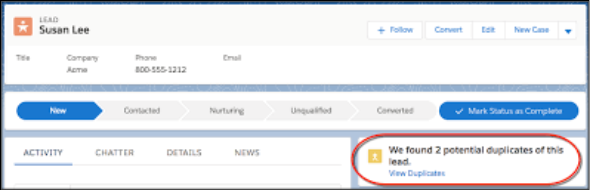
Duplicate records fragment the customer context. A single person may exist as multiple Contacts, Leads, or even Accounts, each with different activity history, ownership, or related records. This is common in orgs that have grown over time or integrated multiple systems. When an Agentforce agent queries Salesforce, it does not reason about duplicates the way a human does. If the agent looks up a contact by email and multiple records are returned, it has no reliable way to determine which one represents the real customer. In many cases, it simply uses the first record returned by the query, which is often the oldest or least complete.
This leads to very real failures. An agent may reference the wrong order history, miss previous support cases, or take action on an outdated record. The agent is not malfunctioning; it is working with a fragmented version of reality.
Inconsistent Field Usage
Fields drifting from their original purpose are another common issue. A field intended to store a lifecycle stage might later be used as a free-text notes field. Different teams may populate the same field with slightly different meanings. Over time, values that look similar to humans become inconsistent at scale. Agentforce treats structured fields as signals. From a technical perspective, it uses field values to filter data, personalize responses, and decide what actions to take, and it assumes those values are consistent.
When the same concept is represented in multiple ways, such as “United States,” “USA,” and “U.S.,” the agent treats them as distinct values, unless instructed not to. Humans normalize this automatically, but AI agents do not. The result is incorrect filtering, missed context, and responses that do not align with how the business actually operates.

Missing Critical Context
Incomplete records force Agentforce to guess. Contacts without full profiles, Accounts missing industry or ownership, or records saved with the intention to fill in details later all create gaps in context. Agentforce relies on this context to understand who it is interacting with and how to respond. When key fields are missing, the agent does not know that information is absent. It still has to answer questions or take action.
Technically, this pushes the agent into inference mode. It relies on patterns instead of facts, and this is where hallucinations come from. Not because the AI is unreliable, but because it is reasoning without enough information to do so safely.
Undocumented Processes
Many Salesforce orgs function on institutional knowledge. Sales teams know when to escalate. Support teams know which exceptions are allowed. Admins understand edge cases that are never formally documented. Agentforce cannot rely on unwritten rules. It can only act on what is explicitly represented in data, logic, and metadata. If a process is not clearly reflected in Salesforce, the agent cannot apply it consistently.
This leads to uneven behavior. Similar cases may be handled differently depending on which data happens to be present. From the outside, this looks like unpredictable AI behavior. In reality, the system is simply missing the rules it needs.
Outdated or Poorly Maintained Integrations
Most Salesforce orgs rely on integrations for billing, marketing, events, or support. Over time, these integrations may partially fail, stop syncing certain fields, or continue running without active monitoring. Agentforce treats integrated data as authoritative. It has no built-in mechanism to verify whether that data is current or complete. If an Account shows outdated pricing or an order status that is never updated, the agent assumes it is correct.
This leads to situations where agents quote the wrong pricing, reference outdated contracts, or provide answers that conflict with downstream systems. The data looks valid; the outcome is not.
What Actually Breaks When Data Isn’t Ready
When these issues exist, Agentforce does not crash - it responds confidently with incorrect or incomplete information. That confidence is what creates risk, especially in customer-facing scenarios. The problem is not visibility; the problem is trust. Once users or customers lose confidence in agent responses, adoption drops quickly.
And unlike a bad flow that affects one process, Agentforce touches every interaction it's deployed to handle.
The Pre-Deployment Data Audit: Where to Start
Before deploying Agentforce, organizations should evaluate their data with AI use in mind. This does not require a full rebuild, but it does require clarity around what the agent will touch and how reliable that data is.
A practical starting point:
- Deduplicate core objects - Contacts, Accounts, Leads - and define a clear source of truth
- Standardize high-impact fields - Review for consistent usage and values
- Audit record completeness - Confirm ownership, lifecycle stage, and industry data are populated
- Document key processes - As they exist in Salesforce today, not how people believe they work
- Review integrations - Verify data is current, complete, and actively monitored
The goal is not perfect data. The goal is to reduce ambiguity before AI begins reasoning on your behalf.
The Real Question to Ask
If your organization has purchased Agentforce or is considering it, the most important question is whether your data can support autonomous decision-making. Agentforce doesn’t correct data at the source. It can handle minor gaps, but unresolved data issues continue to affect how the agent responds and acts over time, amplifying the problem.
Agentforce often acts as a forcing function. The same data issues have existed for years, but humans were able to work around them. AI agents expose those issues immediately and at scale, and if your Salesforce data quality is low, your new AI agent might end up surfacing data problems for humans to fix, rather than actually streamlining work.
If you are unsure where your data stands, ECHO offers targeted data audits and pre-deployment assessments to identify the issues that matter most before Agentforce goes live. The goal is not just to make Agentforce work, but to make your Salesforce org healthier overall.
Schedule a consultation to understand what needs to be fixed before you go live.
Continue Reading


%20(12).png)
Transform What’s Possible With
Salesforce
Traction Rec
Litify
Salesforce
Unlock the full potential of your platforms and make the impossible a reality with ECHO Technology Solutions.


