Salesforce Flow Orchestration - An Overview for Nonprofits

%20(2).png)
Get Expert Salesforce, Traction Rec and Litify Support
Handling any business process that involves multiple teams, departments, or critical timelines can quickly become overwhelming. Even when everyone is committed and organized, it’s easy for tasks to be forgotten, deadlines to slip, or steps to be completed out of order. Teams can spend hours tracking progress, sending follow-up emails, or manually checking that everyone has completed their part, which not only consumes time but also increases stress and reduces efficiency.
This is exactly the kind of challenge that Salesforce Flow Orchestration is designed to solve. Salesforce Flow Orchestration allows you to coordinate complex, multi-step processes directly in Salesforce. Instead of relying on manual work, emails, and automations that are not connected or made to work as a single system, Flow Orchestration organizes automated actions into a structured process.
To understand Flow Orchestration, it is important to understand Salesforce Flows. Flows are automated processes that can collect data, update records, send emails, or perform other actions in Salesforce. While individual flows are powerful, complex processes often involve multiple flows, approvals, and task assignments.
Flow Orchestration leverages Flow functionality to sequence and schedule multiple flows, assign tasks to specific users or teams, and track progress across the entire organization. This is especially valuable for nonprofits where many processes involve multiple departments, such as fundraising, development, programs, finance, and volunteer management.
The result is always a more consistent process and reduced manual work, which ensures that important activities aren’t forgotten or delayed.
As of recent Salesforce updates, Flow Orchestration is included as a standard Flow capability, making it easier for nonprofits to explore complex, multi‑user automation without additional licensing overhead.
Use Cases for Nonprofits
Gift or Donation Processing
Donation processing is usually a repetitive task for fundraising teams, which is always encouraged to be automated. This is true especially if we’re talking about large donations, which may require coordination between fundraising, finance, and leadership teams.
Nonprofits can use Flow Orchestration to automate different aspects of donation management, from notifying staff when major donations are created to assigning tasks to the relevant team members, generating thank‑you letters, and creating structured follow‑up plans.
Volunteer Management
Volunteer programs often require coordination between volunteer managers, program coordinators, and sometimes HR. It is usually a complex process that requires examining multiple criteria that affect decision-making.
Many organizations use Flow Orchestration to automate volunteer processes, including application intake, selection phases, manager assignments, onboarding, and tracking each volunteer’s current and past involvement.
Event Registration and Coordination
Many nonprofits organize events such as fundraisers, community programs, or training workshops, which require coordination across multiple teams.
Flow Orchestration helps send invitations, automatically register participants, and collect data about their attendance, as well as trigger post‑event follow‑ups (thank‑you letters, surveys, etc.). Dashboards can automatically be updated with attendance, volunteer hours, or collected donations.
Program Participation Management
Some nonprofits manage multi-session programs or classes that require thorough management of the whole process. The process can vary, but Flow Orchestration is well-suited for handling even highly complex program structures.
This often includes moving participants from initial leads to applicants, saving applications and preferences, sending personalized offers and welcome letters, and tracking their journey and program history.
Benefits for Nonprofits
Flow Orchestration is one of the most important Salesforce features because of its ability to handle complexity and to save staff time. It ensures tasks are automatically routed to the right people, reducing internal communication gaps. Also, staff can see where a process stands, who owns the next step, and whether tasks are overdue.
Processes are consistent, meaning that every process follows its set of workflows. Customization is allowed even if the process is complex, helping organizations broaden their criteria sets.
Manual work is significantly reduced. Automated steps and task assignments replace email chains, spreadsheets, and manual tracking. Processes move faster and more reliably, improving the experience for everyone involved.
Flow chart example: Program Participation
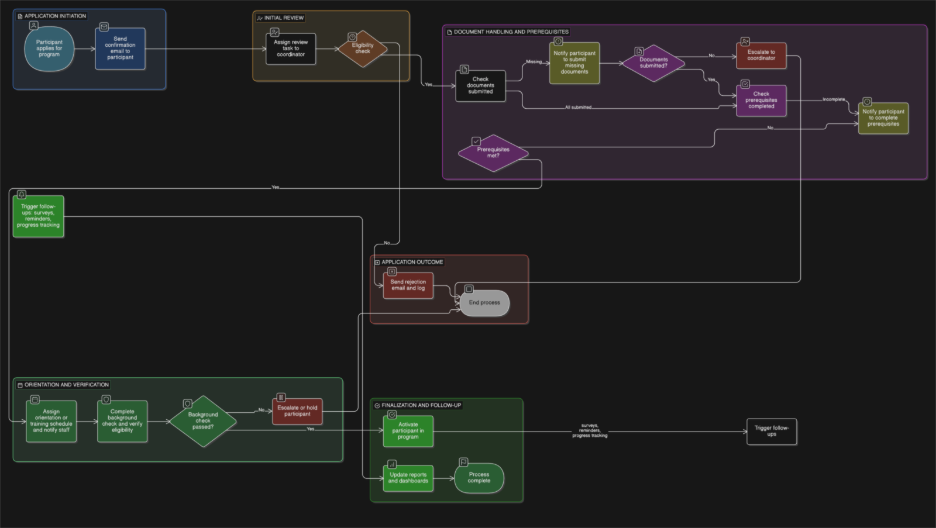
Based on our work with nonprofits, we often see these orchestration patterns applied across fundraising, programs, and operations. If you have questions or would like help designing and implementing Flow Orchestration for your nonprofit, we invite you to reach out to the team at ECHO for expert guidance and support.
Continue Reading

%20(12).png)
Transform What’s Possible With
Salesforce
Traction Rec
Litify
Salesforce
Unlock the full potential of your platforms and make the impossible a reality with ECHO Technology Solutions.


